
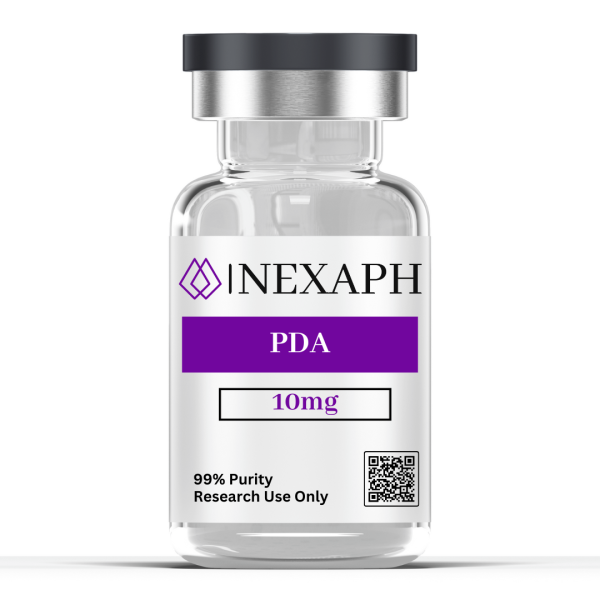
PDA 10mg (10 vials/kit): Specialized Analytical Reagent for Advanced Cellular Signaling & Bioassays
In cellular damage and senescence models, exposure to reactive oxygen species ($\text{ROS}$) or ultraviolet radiation disrupts nuclear DNA integrity and triggers mitochondrial membrane depolarization. Research demonstrates that PDA modulates nuclear factor erythroid 2-related factor 2 ($\text{Nrf2}$) translocation, upregulating downstream endogenous antioxidant enzymes such as superoxide dismutase ($\text{SOD}$), catalase ($\text{CAT}$), and glutathione peroxidase ($\text{GSH-Px}$):
This activation cascade helps neutralize free radicals, suppress lipid peroxidation, and preserve mitochondrial bioenergetics under induced stress conditions.
Maintaining batch-to-batch consistency and high chemical stability is critical for quantitative cell culture assays and Western blot kinetic analyses. The PDA 10mg (10 vials/kit) product configuration delivers a total yield of 100mg active research compound (10mg per vial) distributed across ten individual USP Type I borosilicate glass vials. Freeze-dried under sterile vacuum conditions, each vial contains a uniform, highly stable lyophilized cake. This multi-vial kit structure enables laboratory personnel to reconstitute only the working concentration needed for immediate experimental runs, keeping remaining stock preserved in deep-freeze stasis to protect against thermal degradation and hydrolytic loss.
Biochemical Pathways, Cytoprotective Mechanisms, and Technical Profile
The primary scientific value of PDA 10mg (10 vials/kit) stems from its selective receptor interactions and multi-pathway cytoprotective signaling dynamics:
-
SIRT1/AMPK Pathway Modulation: Activates $\text{SIRT1}$ deacetylation and $\text{AMPK}$ phosphorylation cascades to regulate cellular energy homeostasis and mitochondrial biogenesis.
-
Nrf2-Mediated Antioxidant Induction: Upregulates nuclear translocation of $\text{Nrf2}$, enhancing antioxidant response element ($\text{ARE}$) gene expression to counteract intracellular oxidative damage.
-
Anti-Apoptotic Signaling Balance: Modulates the $\text{Bcl-2}/\text{Bax}$ protein ratio and inhibits caspase-3/caspase-9 cleavage, preserving cell viability during ischemic or cytotoxic stress models.
-
Pro-Inflammatory Cytokine Suppression: Downregulates nuclear factor-$\kappa\text{B}$ ($\text{NF-}\kappa\text{B}$) transcriptional activity, suppressing production of inflammatory mediators like $\text{TNF-}\alpha$, $\text{IL-1}\beta$, and $\text{IL-6}$.
-
High Analytical Purity ($\ge$99.0%): Produced via high-yield chemical/solid-phase synthesis and purified using preparative High-Performance Liquid Chromatography ($\text{HPLC}$) to ensure complete removal of synthetic byproducts and impurities.
| Biochemical / Technical Parameter | Technical Profile for PDA 10mg (10 vials/kit) |
| Product Identifier | PDA 10mg (10 vials/kit) / Research Compound Complex |
| Chemical Purity | $\ge$99.0% (Verified by analytical HPLC peak integration) |
| Physical Appearance | White to off-white, sterile lyophilized powder cake |
| Package Configuration | 10 USP Type I Borosilicate Glass Vials per Kit (10mg per vial) |
| Solubility Profile | Soluble in Sterile Water, Normal Saline ($0.9\% \text{ NaCl}$), PBS ($\text{pH } 7.4$), or DMSO |
| Primary Research Domains | Nrf2/SIRT1 signaling, cytoprotection, cellular stress models, mitochondrial homeostasis |
Reconstitution Protocols, Laboratory Storage Standards, and Quality Control
To maintain bioactive structural integrity and ensure reproducible assay outcomes when working with PDA 10mg (10 vials/kit), researchers should follow standardized laboratory preparation and climate-controlled storage protocols.
Perform all reconstitution procedures inside a certified Class II Biosafety Cabinet:
-
Temperature Balancing: Allow the frozen PDA vial to adjust to ambient room temperature prior to solvent introduction to eliminate condensation inside the glass container.
-
Septum Sanitization: Remove the protective plastic flip-cap and thoroughly wipe the synthetic rubber stopper with a fresh 70% isopropyl alcohol pad. Allow the surface to air-dry completely.
-
Slow Diluent Addition: Using a sterile syringe equipped with a fine-gauge needle, draw the required volume of Bacteriostatic Water (0.9% benzyl alcohol), Sterile Normal Saline (0.9% NaCl), or Phosphate-Buffered Saline (PBS). Direct the liquid stream against the inner glass wall so it trickles slowly over the lyophilized cake.
-
Gentle Hydration: Allow the diluent to fully hydrate the powder cake for 2 minutes. Gently roll the vial between your palms or swirl in smooth circular motions until clear. Never vortex or shake violently, as high-shear agitation can cause mechanical degradation or excessive foaming.
-
Aliquoting Strategy: For extended testing protocols, divide reconstituted liquid into sterile, single-use microcentrifuge tubes under aseptic conditions to prevent atmospheric oxidation and eliminate repeated freeze-thaw cycles.
| Operational Storage Phase | Recommended Environmental Conditions | Bioactive Stability Duration |
| Unopened Lyophilized Kit | Deep Freeze at -20°C to -80°C (Protected from light and moisture) | 24 to 36 Months |
| Unopened Short-Term Storage | Refrigerated at 2°C to 8°C (Sealed dark storage container) | Up to 90 Days |
| Reconstituted Solution | Refrigerated at 2°C to 8°C (In Bacteriostatic Water or Saline) | Up to 21–28 Days |
| Frozen Liquid Aliquots | Deep Freeze at -20°C or colder (Single freeze-thaw max) | Up to 6 Months |
Batch Quality Documentation & Traceability: Every production lot of PDA 10mg (10 vials/kit) undergoes third-party analytical verification. High-Performance Liquid Chromatography (HPLC) chromatograms confirm component purity exceeding 99.0%, while Electrospray Ionization Mass Spectrometry (ESI-MS) verifies molecular identity. Each shipment includes a lot-specific Certificate of Analysis (COA) documenting chemical purity, residual solvent analysis, heavy metal screens, and bacterial endotoxin testing (<0.05 EU/mg) to satisfy institutional compliance requirements.
Strict Regulatory & Research Compliance Statement: PDA 10mg (10 vials/kit) is manufactured, packaged, and distributed exclusively for in vitro laboratory research, academic experimentation, chemical synthesis, and preclinical research. PDA 10mg (10 vials/kit) is strictly not intended, formulated, or approved for human or animal consumption, therapeutic medical treatment, clinical diagnostic work, or cosmetic applications. All handling must be conducted by certified research personnel operating within equipped laboratory facilities in compliance with OSHA workplace safety regulations and institutional biosafety protocols.
Be the first to review “PDA 10mg (10 vials/kit)”
Related products
Peptide
Reviews
There are no reviews yet.