
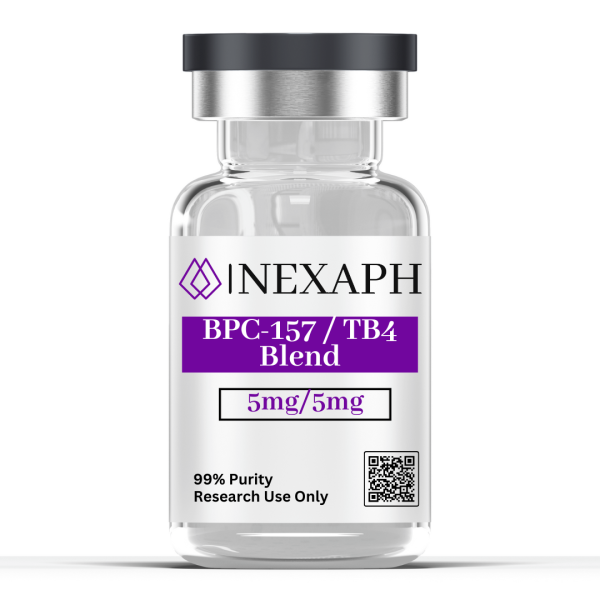
BPC-157 / TB4 Blend – 5mg/5mg (10 vials/kit): Synergistic Multi-Pathway Tissue Repair Complex
In modern regenerative science, tissue recovery relies on two distinct cellular processes: localized signal activation for vessel formation and global cellular motility across damaged extracellular matrices. BPC-157 acts primarily as a localized cytoprotective agent that upregulates growth factor expression and stabilizes damaged endothelium, whereas Thymosin Beta-4 acts as an actin-sequestering protein that drives cell movement, lamellipodia formation, and re-epithelialization. Combining these biomolecules into a single 1:1 stoichiometric ratio enables researchers to explore potential additive or synergistic signaling without the confounding variables introduced by separate reagent reconstitution.
Reagent stability and precise concentration control are critical for generating consistent, reproducible data in cell culture and preclinical models. The BPC-157 / TB4 Blend – 5mg/5mg (10 vials/kit) configuration delivers 100mg of total active peptide material across ten individual 10mg USP Type I borosilicate glass vials (50mg total BPC-157 and 50mg total TB4 per kit). Freeze-dried under sterile vacuum conditions, each vial contains a stable lyophilized powder cake. This multi-vial system enables laboratory personnel to hydrate only the necessary stock for active testing schedules, keeping remaining vials protected from thermal degradation, oxidation, and structural loss caused by repeated freeze-thaw cycles.
Dual Biochemical Mechanisms and Research Applications of the BPC-157 / TB4 Blend
The primary rationale behind the BPC-157 / TB4 Blend – 5mg/5mg (10 vials/kit) lies in the complementary biological mechanisms executed by its two constituent peptides:
-
BPC-157 (Pentadecapeptide – 5mg/vial): A 15-amino acid sequence derived from human gastric juice protein that demonstrates profound cytoprotective and healing properties. BPC-157 modulates the Vascular Endothelial Growth Factor (VEGF) signaling pathway, accelerates Early Growth Response-1 (EGR-1) gene expression, and regulates endothelial nitric oxide synthase (eNOS) activation. It promotes rapid tendon-to-bone healing, mucosal repair, and tendon fibroblast survival while downregulating pro-inflammatory cytokines.
-
TB4 / TB-500 (Thymosin Beta-4 – 5mg/vial): A 43-amino acid peptide that acts as the primary intracellular G-actin sequestering molecule in mammalian cells. By binding to globular actin, TB4 prevents premature actin polymerization and maintains a fluid pool of actin monomers required for cell movement, cell spreading, and tissue repair. It enables keratinocytes, endothelial cells, and myoblasts to migrate rapidly into injured tissue areas, promoting cardiac tissue remodeling, corneal repair, and hair follicle activation.
-
Synergistic Angiogenesis & Microvascular Growth: Simultaneous activation of VEGF expression (via BPC-157) and endothelial cell migration (via TB4) promotes rapid capillary sprout formation and nutrient delivery in ischemic tissue models.
-
Actin Cytoskeleton & Cell Motility Regulation: TB4 provides the structural framework for cell migration across extracellular matrix gaps, while BPC-157 upregulates growth factor receptors to guide directional cell growth.
-
Musculoskeletal & Tendon Repair: Accelerates collagen deposition, tenocyte migration, and mechanical load recovery in ligament, tendon, and muscle injury models.
-
Mucosal Barrier & Gastrointestinal Integrity: BPC-157 restores tight junction barrier protein expression (ZO-1, Occludin) in gut epithelial cells, while TB4 reduces local inflammatory cell infiltration.
-
Ultra-High Analytical Purity ($\ge$99.0%): Both peptides are synthesized using automated Solid-Phase Peptide Synthesis (SPPS) and purified through High-Performance Liquid Chromatography (HPLC) to ensure complete removal of truncated sequence impurities.
| Biochemical / Technical Parameter | Specification Profile for BPC-157 / TB4 Blend |
| Product Identifier | BPC-157 / TB4 Blend – 5mg/5mg (10 vials/kit) |
| Active Ingredients | BPC-157 (5mg) + Thymosin Beta-4 / TB-500 (5mg) |
| Total Active Mass per Vial | 10mg Lyophilized Peptide Cake per Vial |
| Total Kit Yield | 100mg Total Active Research Material (10 Vials per Kit) |
| Chemical Purity | $\ge$99.0% (Verified by HPLC analytical peak integration) |
| Physical Appearance | Sterile white to off-white lyophilized powder |
| Container Specification | 10 USP Type I Borosilicate Glass Vials with Flip-Off Seals |
| Synthesis Method | Automated Solid-Phase Peptide Synthesis (SPPS) |
| Primary Analytical Assays | High-Performance Liquid Chromatography (HPLC) & LC-MS |
Reconstitution Guidelines, Laboratory Storage Standards, and Quality Protocols
Maintaining the chemical structure and bioactivity of the BPC-157 / TB4 Blend – 5mg/5mg (10 vials/kit) requires strict adherence to standardized laboratory preparation and storage protocols. Multi-peptide solutions can experience hydrolytic cleavage, oxidation, or structural aggregation if subjected to improper pH levels, direct ambient light, or high mechanical shear stress.
Follow these standardized operating steps inside a certified Class II Biosafety Cabinet when preparing the BPC-157 / TB4 Blend – 5mg/5mg (10 vials/kit) for in vitro or in vivo research:
-
Temperature Equilibration: Remove the lyophilized vial from cold storage and allow it to reach ambient room temperature prior to reconstitution to eliminate internal vial condensation.
-
Septum Sanitization: Flip off the protective cap and thoroughly wipe the synthetic rubber stopper with a sterile 70% isopropyl alcohol pad. Allow the surface to air-dry completely.
-
Slow Diluent Introduction: Using a sterile syringe with a fine-gauge needle, draw the desired volume of Bacteriostatic Water (0.9% benzyl alcohol) or Sterile Normal Saline (0.9% NaCl). Incline the vial at 45 degrees and direct the liquid stream down the inner glass wall so it slowly trickles over the powder cake.
-
Gentle Dissolution: Allow the diluent to absorb into the lyophilized cake for 2–3 minutes. Gently roll the vial between your palms or swirl in smooth circular motions until the liquid becomes completely clear and colorless. Never vortex or shake vigorously, as turbulent mechanical forces can shear delicate peptide chains and induce foaming.
-
Micro-Aliquot Storage: For long-term or multi-assay research, divide the reconstituted solution into single-use, sterile microcentrifuge tubes under laminar flow conditions to prevent atmospheric oxidation and eliminate repeated freeze-thaw cycles.
| Storage Phase | Recommended Environmental Conditions | Bioactive Stability Duration |
| Unopened Lyophilized Kit | Deep Freeze at -20°C to -80°C (Protected from light and moisture) | 24 to 36 Months |
| Unopened Short-Term Storage | Refrigerated at 2°C to 8°C (Sealed dark storage container) | Up to 90 Days |
| Reconstituted Solution | Refrigerated at 2°C to 8°C (In Bacteriostatic Water or Saline) | Up to 28–30 Days |
| Reconstituted Aliquots | Deep Freeze at -20°C or colder (Single freeze-thaw cycle max) | Up to 6 Months |
Analytical Quality & Lot Traceability: Every production lot of the BPC-157 / TB4 Blend – 5mg/5mg (10 vials/kit) undergoes third-party analytical testing. High-Performance Liquid Chromatography (HPLC) chromatograms confirm purity levels above 99.0%, while Liquid Chromatography-Mass Spectrometry (LC-MS) verifies the precise molecular weights of both BPC-157 and TB4. Each kit includes a batch-specific Certificate of Analysis (COA) documenting chemical purity, heavy metal screening, residual solvent analysis, and bacterial endotoxin levels (<0.05 EU/mg) to support institutional review board (IRB) compliance.
Strict Regulatory & Research Compliance Statement: The BPC-157 / TB4 Blend – 5mg/5mg (10 vials/kit) is produced, packaged, and distributed strictly for laboratory research, in vitro biochemical testing, chemical synthesis, and preclinical research. The BPC-157 / TB4 Blend – 5mg/5mg (10 vials/kit) is strictly not intended, formulated, or approved for human or animal consumption, medical diagnosis, clinical treatment, or cosmetic application. All handling must be conducted by qualified research personnel operating inside certified laboratory facilities in accordance with OSHA safety standards and local biosafety protocols.
Be the first to review “BPC-157 / TB4 Blend – 5mg/5mg (10 vials/kit)”
Related products
Peptide
Peptide
Peptide
Reviews
There are no reviews yet.