
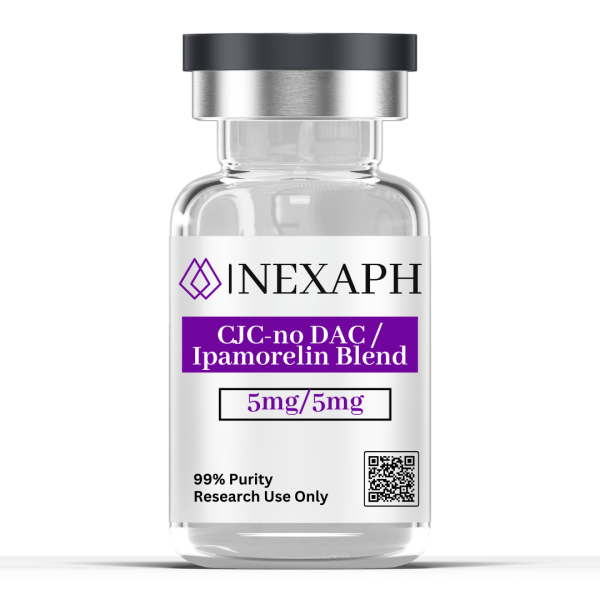
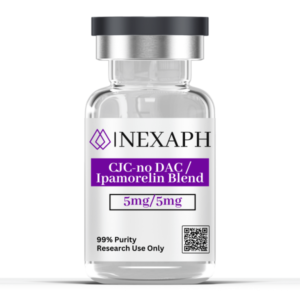
CJC-no DAC / Ipamorelin Blend: Premier Synergistic Growth Hormone Secretagogue Matrix
In physiological endocrinology, anterior pituitary somatotrophs are regulated through a dual-control feedback loop: Growth Hormone-Releasing Hormone (GHRH) stimulates GH synthesis and release, while ghrelin receptor activation amplifies the magnitude of each secretory pulse. Single-peptide administration often yields sub-maximal receptor recruitment or requires higher concentrations that risk receptor desensitization. The CJC-no DAC / Ipamorelin Blend circumvents these limitations by pairing a 29-amino-acid GHRH analog with a 5-amino-acid pentapeptide ghrelin mimetic. This co-formulation achieves additive, and often supra-additive, intracellular signaling in somatotroph cultures, offering superior bioactivity compared to either compound tested in isolation.
Protecting delicate synthetic peptides against chemical hydrolysis, amino acid oxidation, and physical aggregation is critical for generating reproducible scientific data. The CJC-no DAC / Ipamorelin Blend is produced using automated Solid-Phase Peptide Synthesis (SPPS) and purified via High-Performance Liquid Chromatography (HPLC) to achieve a purity threshold of ≥99.0%. Lyophilized under sterile high-vacuum conditions, each vial contains a uniform, stable cake consisting of precisely calibrated ratios (typically 1:1 or 2:1 ratios, such as 2mg CJC-no DAC paired with 2mg Ipamorelin, or 5mg CJC-no DAC paired with 5mg Ipamorelin). Packaging this dual-peptide matrix in USP Type I borosilicate glass vials preserves long-term molecular stability, ensuring consistent concentration across all experimental replicates.
Biological Mechanisms, Dual-Pathway Agonism, and Key Research Applications of the CJC-no DAC / Ipamorelin Blend
The scientific rationale behind the CJC-no DAC / Ipamorelin Blend rests on its ability to trigger two complementary intracellular cascades within pituitary somatotrophs:
-
GHRH Receptor Activation via CJC-1295 (no DAC): CJC-1295 without DAC is a synthetic analog of human growth hormone-releasing hormone (GHRH 1-29) modified at positions 2, 8, 15, and 27 to resist enzymatic cleavage by Dipeptidyl Peptidase IV (DPP-IV). Binding to the GHRH receptor activates the Adenylyl Cyclase / Cyclic AMP (cAMP) / Protein Kinase A (PKA) pathway, which promotes the transcription of growth hormone genes and mobilizes GH storage vesicles toward the cell membrane. With a biological half-life of approximately 30 minutes, CJC-no DAC creates a natural, sharp secretory curve that mimics endogenous physiological pulses.
-
GHSR-1a Agonism via Ipamorelin: Ipamorelin is a selective pentapeptide (Aib-His-D-2Nal-D-Phe-Lys-NH2) that binds directly to the Growth Hormone Secretagogue Receptor (GHSR-1a / ghrelin receptor). This binding triggers the Phospholipase C (PLC) / Inositol Triphosphate (IP3) / Diacylglycerol (DAG) cascade, causing intracellular calcium release that prompts exocytosis of GH-containing vesicles. Crucially, Ipamorelin is exceptionally selective—unlike older secretagogues like GHRP-2 or GHRP-6, it does not stimulate Adrenocorticotropic Hormone (ACTH), cortisol, prolactin, or aldosterone, making the CJC-no DAC / Ipamorelin Blend ideal for isolated GH research without confounding hormonal artifacts.
-
Amplified Pulsatile Growth Hormone Release: Co-activation of GHRH-R and GHSR-1a produces a synergistic surge in systemic GH concentration that exceeds the sum of individual peptide responses.
-
Insulin-like Growth Factor 1 (IGF-1) Induction: Downstream hepatic signaling elevates circulating IGF-1 levels, driving research into cellular proliferation, nitrogen retention, and extracellular matrix repair.
-
Metabolic Rate & Lipolysis Signaling: Enables targeted investigation into beta-oxidation pathways, adipocyte lipolysis, and nutrient partitioning without altering fasting blood glucose homeostasis.
-
Connective Tissue & Collagen Remodeling: Accelerates fibroblast proliferation, osteoblast activity, and collagen type I/III crosslinking in tendon, ligament, and bone tissue repair models.
-
Preservation of Endocrine Sensitivity: Because CJC-no DAC lacks the Drug Affinity Complex (which prolongs half-life for days and can lead to continuous basal elevation), the blend respects natural pulsatile pituitary refractory periods, avoiding pituitary somatotroph exhaustion or desensitization.
Reconstitution Guidelines, Laboratory Storage Standards, and Quality Assurance for the CJC-no DAC / Ipamorelin Blend
Maintaining the structural integrity of the CJC-no DAC / Ipamorelin Blend requires standard laboratory protocols during reconstitution and storage. Synthetic peptides are prone to deamidation, aggregation, or peptide bond hydrolysis if subjected to temperature fluctuations, improper pH solvents, or vigorous mechanical stress.
Follow these standardized laboratory steps when preparing the CJC-no DAC / Ipamorelin Blend for in vitro bioassays or pre-clinical models:
-
Equilibration & Sanitization: Remove the lyophilized CJC-no DAC / Ipamorelin Blend vial from cold storage and allow it to adjust to ambient room temperature inside a Class II Biosafety Cabinet. Swab the rubber septum thoroughly with a 70% isopropyl alcohol wipe and allow it to dry completely.
-
Diluent Selection & Injection: Draw the desired volume of Bacteriostatic Water (0.9% benzyl alcohol) or Sterile Normal Saline (0.9% NaCl) using a fine-gauge needle. Incline the vial at a 45-degree angle and slowly insert the needle through the center of the stopper. Direct the liquid stream against the inner glass wall so that it trickles gently over the lyophilized cake.
-
Hydration & Gentle Dissolution: Allow the diluent to absorb into the powder cake for 2 to 3 minutes without agitation. Gently roll the vial between your palms or swirl in smooth circular movements until the cake dissolves into a completely clear, colorless solution. Do not shake or vortex, as shearing forces can denature peptide secondary structure and cause protein foaming.
-
Sub-Aliquoting Strategy: To maintain maximum chemical stability across multi-week testing protocols, divide the reconstituted CJC-no DAC / Ipamorelin Blend solution into sterile microcentrifuge tubes under aseptic conditions. This practice minimizes exposure to atmospheric oxygen and avoids repetitive freeze-thaw cycles.
Analytical Quality Verification: Every lot of the CJC-no DAC / Ipamorelin Blend is validated through third-party analytical testing. High-Performance Liquid Chromatography (HPLC) chromatograms confirm individual component purity exceeding 99.0%, while Electrospray Ionization Mass Spectrometry (ESI-MS) confirms exact molecular mass for both CJC-1295 (no DAC) and Ipamorelin. Each shipment includes a lot-specific Certificate of Analysis (COA) documenting purity metrics, residual solvent analysis, heavy metal screens, and bacterial endotoxin levels (<0.05 EU/mg) to meet institutional research standards.
Strict Regulatory & Scientific Compliance Statement: The CJC-no DAC / Ipamorelin Blend is manufactured, packaged, and distributed strictly for laboratory research, in vitro biochemical testing, cellular analysis, and preclinical research. The CJC-no DAC / Ipamorelin Blend is explicitly not intended, formulated, or approved for human or animal consumption, clinical diagnostics, therapeutic medical treatment, or cosmetic application. All handling must be conducted by qualified research personnel operating inside equipped laboratory facilities in compliance with OSHA guidelines and institutional safety protocols.
Be the first to review “CJC-no DAC / Ipamorelin Blend 5mg/5mg (10 vials/kit)”
Related products
Peptide
Peptide
Reviews
There are no reviews yet.