
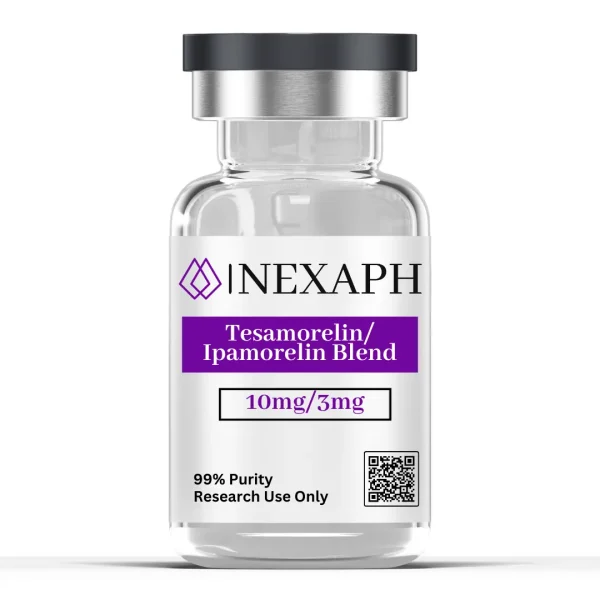
Tesamorelin / Ipamorelin Blend: Advanced Synergistic Growth Hormone Secretagogue Matrix
In physiological research, single-receptor agonist protocols often fail to achieve maximum physiological pulse amplitude due to natural regulatory bottlenecks within the hypothalamic-pituitary axis. GHRH analogs initiate GH synthesis and vesicle priming, while ghrelin receptor agonists trigger immediate intracellular calcium release to induce exocytosis. Combining Tesamorelin and Ipamorelin in a co-formulated solution creates a synergistic amplification loop. Tesamorelin exhibits superior metabolic specificity and resistance to enzymatic cleavage compared to standard GHRH fragments, while Ipamorelin provides clean, selective receptor activation without elevating plasma cortisol, prolactin, or aldosterone levels.
To preserve reagent stability and prevent micro-aggregation, the Tesamorelin / Ipamorelin Blend is manufactured using automated Solid-Phase Peptide Synthesis (SPPS) and purified via preparative High-Performance Liquid Chromatography (HPLC) to achieve a purity threshold of $\ge$99.0%. Lyophilized under high-vacuum conditions, each USP Type I borosilicate glass vial contains a stable, uniform powder cake (typically formulated in popular research ratios such as 5mg Tesamorelin paired with 5mg Ipamorelin, or 10mg total blended peptide mass per vial). Packaging this dual-peptide complex in vacuum-sealed vials ensures long-term chemical stasis and reproducible experimental bioassays across test replicates.
Dual Mechanisms, Visceral Lipolysis, and Target Research Domains of the Tesamorelin / Ipamorelin Blend
The primary bioactivity of the Tesamorelin / Ipamorelin Blend relies on the complementary, non-overlapping signal pathways of its two peptide components:
-
GHRH Receptor Binding via Tesamorelin: Tesamorelin binds directly to GHRH receptors on anterior pituitary somatotrophs, activating Adenylyl Cyclase to elevate intracellular Cyclic AMP (cAMP) and Protein Kinase A (PKA). This pathway accelerates growth hormone gene transcription, enhances cellular GH synthesis, and specifically upregulates metabolic lipolysis pathways targeting visceral adipose tissue (VAT).
-
GHSR-1a Agonism via Ipamorelin: Ipamorelin selectively targets the Growth Hormone Secretagogue Receptor (GHSR-1a), activating the Phospholipase C (PLC) / Inositol Triphosphate (IP3) signaling cascade. This mobilizes intracellular calcium stores to trigger rapid exocytosis of pre-stored GH vesicles without activating stress hormones or appetite-stimulating pathways.
-
Targeted Visceral Adipose Tissue (VAT) Oxidation: Tesamorelin’s unique lipolytic potency facilitates research into abdominal visceral fat reduction, hepatic lipid clearance, and metabolic syndrome models.
-
Amplified Endogenous GH & IGF-1 Cascades: Co-activation produces a pulse amplitude higher than single-peptide protocols, driving downstream hepatic synthesis of Insulin-like Growth Factor 1 (IGF-1).
-
High Receptor Selectivity: Maintains endocrine baseline stability without provoking off-target surges in ACTH, cortisol, ghrelin, or prolactin.
-
Tissue Repair & Extracellular Matrix Support: Accelerates collagen production, nitrogen retention, and cellular turnover in musculoskeletal and cutaneous recovery assays.
| Technical Parameter | Specification Profile for Tesamorelin / Ipamorelin Blend |
| Product Identifier | Tesamorelin / Ipamorelin Blend |
| Active Component 1 | Tesamorelin (44-amino-acid GHRH Analog with trans-3-hexenoic group) |
| Active Component 2 | Ipamorelin (Selective GHSR-1a Agonist Pentapeptide) |
| Chemical Purity | $\ge$99.0% (Verified via HPLC analytical peak integration) |
| Physical State | Sterile white to off-white lyophilized powder cake |
| Vial Specification | USP Type I Borosilicate Glass Vial with Flip-Off Seal |
| Synthesis Method | Automated Solid-Phase Peptide Synthesis (SPPS) |
| Primary Research Domains | Visceral lipolysis, GHRH/GHSR co-activation, IGF-1 induction, metabolic repair |
Reconstitution Protocols, Storage Guidelines, and Quality Verification
Maintaining peptide integrity requires strict adherence to standardized aseptic reconstitution and climate-controlled storage protocols. Peptides containing long-chain amino sequences, such as Tesamorelin, can be sensitive to mechanical shearing and ambient temperature swings.
Follow these standard laboratory guidelines within a Class II Laminar Flow Biosafety Cabinet:
-
Thermal Balancing & Sanitization: Allow the frozen vial to reach room temperature before reconstitution to avoid internal condensation. Sanitise the rubber septum with a sterile 70% isopropyl alcohol wipe and let it dry completely.
-
Diluent Introduction: Using a sterile syringe with a fine-gauge needle, draw the necessary volume of Bacteriostatic Water (0.9% benzyl alcohol) or Sterile Normal Saline (0.9% NaCl). Incline the vial at 45 degrees and direct the stream down the inner glass wall so the liquid slowly trickles over the powder cake.
-
Hydration & Mixing: Allow the diluent to fully saturate the lyophilized cake for 2–3 minutes. Swirl the vial in a slow circular motion until clear. Do not shake or vortex, as turbulent agitation can disrupt peptide secondary structure.
-
Aliquot Storage: For multi-assay projects, divide the reconstituted solution into sterile single-use microcentrifuge tubes to prevent repeated freeze-thaw cycles.
| Operational Phase | Recommended Storage Parameters | Bioactive Stability Duration |
| Unopened Lyophilized Vial | Freeze at -20°C to -80°C (Protected from light and moisture) | 24 to 36 Months |
| Unopened Short-Term Storage | Refrigerated at 2°C to 8°C (Sealed container) | Up to 90 Days |
| Reconstituted Solution | Refrigerated at 2°C to 8°C (In Bacteriostatic Water) | Up to 28–30 Days |
| Frozen Liquid Aliquots | Deep Freeze at -20°C or colder (Single freeze-thaw cycle max) | Up to 6 Months |
Analytical Quality Verification: Every production batch of the Tesamorelin / Ipamorelin Blend is subjected to third-party analytical validation. High-Performance Liquid Chromatography (HPLC) chromatograms confirm individual component purity exceeding 99.0%, while Liquid Chromatography-Mass Spectrometry (LC-MS) verifies molecular weights. Each lot includes a Certificate of Analysis (COA) documenting chemical purity, residual solvent limits, heavy metal screens, and bacterial endotoxin levels (<0.05 EU/mg).
Strict Regulatory & Research Compliance Statement: The Tesamorelin / Ipamorelin Blend is produced, packaged, and distributed exclusively for laboratory research, in vitro biochemical testing, chemical synthesis, and preclinical research. The Tesamorelin / Ipamorelin Blend is strictly not intended, formulated, or approved for human or animal consumption, medical diagnosis, clinical treatment, or cosmetic application. All handling must be conducted by qualified research personnel operating inside certified laboratory facilities in accordance with OSHA safety standards and local biosafety protocols.
Be the first to review “Tesamorelin / Ipamorelin Blend – 10mg/3mg (10 vials/Kit)”
Related products
Reviews
There are no reviews yet.