
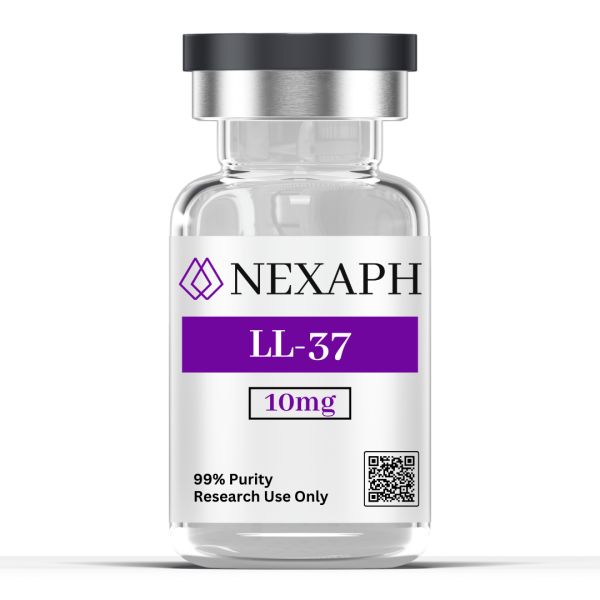
LL-37 10mg (10 vials/kit): Human Cathelicidin Peptide for Host Defense & Wound Healing Research
In microbial membrane dynamics, the cationic cationic charge ($+6$ net charge at physiological $\text{pH}$) of LL-37 facilitates electrostatic binding to negatively charged phospholipid headgroups (such as phosphatidylglycerol and lipoteichoic acid) in bacterial cell walls. Upon binding, the peptide undergoes a conformational transition into a amphipathic $\alpha$-helix that inserts into the lipid bilayer, inducing pore formation, toroidal distortion, and rapid intracellular leakage:
Simultaneously, LL-37 binds circulating bacterial lipopolysaccharide ($\text{LPS}$) molecules with high affinity, competitively blocking $\text{LPS}$ interaction with toll-like receptor 4 ($\text{TLR4}$)/$\text{MD-2}$ complexes on macrophages. This binding sequesters free endotoxins and prevents excessive nuclear factor-$\kappa\text{B}$ ($\text{NF-}\kappa\text{B}$) activation and pro-inflammatory cytokine surges during severe bacterial challenge models.
In tissue repair assays, LL-37 engages formyl peptide receptor-like 1 ($\text{FPRL1}$ / $\text{FPR2}$) on endothelial cells, keratinocytes, and fibroblasts. Activation of $\text{FPR2}$ transactivates the epidermal growth factor receptor ($\text{EGFR}$), promoting cellular proliferation, vascular capillary tube formation, and accelerated wound closure.
The LL-37 10mg (10 vials/kit) configuration yields a total kit payload of 100mg active peptide material (10mg per vial across ten individual USP Type I borosilicate glass vials). Freeze-dried under sterile vacuum conditions, each vial contains a uniform, highly stable lyophilized cake. This multi-vial structure allows laboratory staff to reconstitute single working units for active bioassays while keeping remaining stock preserved in deep-freeze conditions to protect against thermal degradation and secondary oxidation.
Immunomodulation, Membrane Disruption Dynamics, and Technical Profile
The primary scientific value of LL-37 10mg (10 vials/kit) stems from its dual physical-antimicrobial mechanism, receptor-mediated immunomodulation, and angiogenic wound-healing pathways:
-
Broad-Spectrum Lytic Antimicrobial Activity: Electrostatically targets and disrupts bacterial outer membranes via carpet and toroidal-pore mechanisms, minimizing potential microbial resistance development.
-
LPS Neutralization & Anti-Endotoxin Activity: High-affinity binding to lipid A fragments prevents $\text{LPS-TLR4}$ complex assembly and downregulates pro-inflammatory cascades in myeloid cells.
-
FPR2-Mediated Chemotaxis & Re-Epithelialization: Recruits neutrophils, monocytes, and T-cells to tissue injury sites while accelerating keratinocyte migration via $\text{EGFR}$ transactivation.
-
Angiogenesis Stimulation: Promotes endothelial capillary sprout formation and neovascularization in ischemic or impaired dermal tissue models.
-
Ultra-High Chemical Purity ($\ge$99.0%): Manufactured via automated Solid-Phase Peptide Synthesis ($\text{SPPS}$) and purified using preparative High-Performance Liquid Chromatography ($\text{HPLC}$) to ensure complete removal of truncation sequences and synthesis artifacts.
| Biochemical / Technical Parameter | Technical Profile for LL-37 10mg (10 vials/kit) |
| Product Identifier | LL-37 10mg (10 vials/kit) / Human Cathelicidin Active Fragment |
| Chemical Sequence | $\text{LLGDFFRKSKEKIGKEFKRIVQRIKDFLRNLVPRTES}$ |
| CAS Registry Number | 154947-66-7 |
| Molecular Formula | $\text{C}_{205}\text{H}_{340}\text{N}_{60}\text{O}_{53}$ |
| Molecular Mass | Approximately 4493.33 g/mol |
| Chemical Purity | $\ge$99.0% (Verified by analytical HPLC peak integration) |
| Physical Appearance | White to off-white, sterile lyophilized powder cake |
| Package Configuration | 10 USP Type I Borosilicate Glass Vials per Kit (10mg per vial) |
| Primary Research Domains | Antimicrobial resistance, innate host defense, LPS neutralization, dermal wound repair |
Reconstitution Guidelines, Laboratory Storage Standards, and Quality Protocols
Achieving reproducible, publication-grade results when working with LL-37 10mg (10 vials/kit) requires strict adherence to standardized laboratory preparation and climate-controlled storage protocols.
Perform all reconstitution procedures inside a certified Class II Biosafety Cabinet:
-
Temperature Balancing: Allow the frozen LL-37 vial to adjust to ambient room temperature prior to solvent introduction to eliminate moisture condensation inside the glass container.
-
Septum Sanitization: Remove the protective plastic flip-cap and thoroughly wipe the synthetic rubber stopper with a fresh 70% isopropyl alcohol pad. Allow the surface to dry completely.
-
Slow Diluent Addition: Using a sterile syringe equipped with a fine-gauge needle, draw the required volume of Sterile Water, Normal Saline (0.9% NaCl), or Phosphate-Buffered Saline (PBS). Direct the liquid stream against the inner glass wall so it trickles slowly over the lyophilized cake.
-
Gentle Hydration: Allow the diluent to fully hydrate the powder cake for 2 minutes. Gently roll the vial between your palms or swirl in smooth circular motions until clear. Never vortex or shake violently, as high-shear agitation can disrupt peptide secondary structures and induce protein foaming.
-
Micro-Aliquot Strategy: For multi-week testing protocols, divide reconstituted liquid into sterile, single-use microcentrifuge tubes under aseptic conditions to prevent atmospheric oxidation and eliminate repeated freeze-thaw cycles.
| Operational Storage Phase | Recommended Environmental Conditions | Bioactive Stability Duration |
| Unopened Lyophilized Kit | Deep Freeze at -20°C to -80°C (Protected from light and moisture) | 24 to 36 Months |
| Unopened Short-Term Storage | Refrigerated at 2°C to 8°C (Sealed dark storage container) | Up to 90 Days |
| Reconstituted Solution | Refrigerated at 2°C to 8°C (In Bacteriostatic Water or Saline) | Up to 21–28 Days |
| Frozen Liquid Aliquots | Deep Freeze at -20°C or colder (Single freeze-thaw max) | Up to 6 Months |
Batch Quality Documentation & Traceability: Every production lot of LL-37 10mg (10 vials/kit) undergoes third-party analytical testing. High-Performance Liquid Chromatography (HPLC) chromatograms confirm component purity exceeding 99.0%, while Electrospray Ionization Mass Spectrometry (ESI-MS) confirms precise theoretical molecular mass. Each shipment includes a batch-specific Certificate of Analysis (COA) documenting chemical purity, residual solvent analysis, heavy metal screens, and bacterial endotoxin levels (<0.05 EU/mg) to satisfy institutional compliance requirements.
Strict Regulatory & Research Compliance Statement: LL-37 10mg (10 vials/kit) is produced, packaged, and distributed exclusively for in vitro laboratory research, academic experimentation, chemical synthesis, and preclinical research. LL-37 10mg (10 vials/kit) is strictly not intended, formulated, or approved for human or animal consumption, therapeutic medical treatment, clinical diagnostic work, or cosmetic applications. All handling must be conducted by certified research personnel operating within equipped laboratory facilities in compliance with OSHA workplace safety regulations and institutional biosafety protocols.
Be the first to review “LL-37 10mg (10 vials/kit)”
Related products
Peptide
Reviews
There are no reviews yet.