
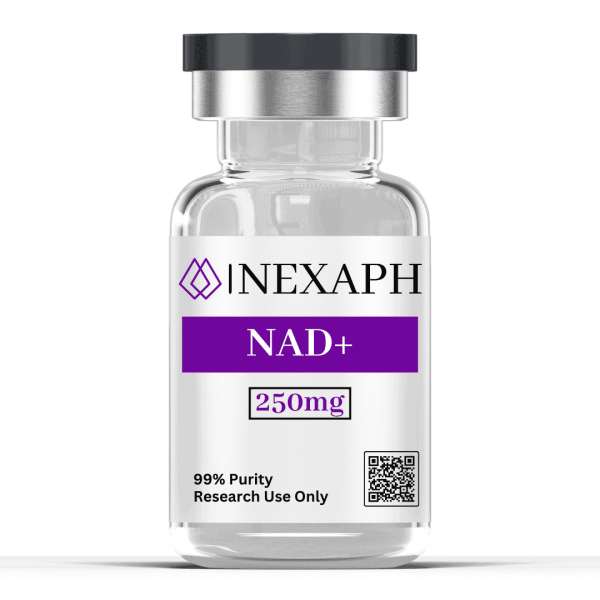
NAD+ 250mg Buffered (10 vials/kit): pH-Stabilized Coenzyme for Cellular Energy & Longevity Research
Nicotinamide Adenine Dinucleotide (NAD+) is a vital, naturally occurring central coenzyme found in every living cell. Existing in two interconvertible states—oxidized ($\text{NAD}^+$) and reduced ($\text{NADH}$)—this essential pyridine nucleotide functions as a crucial electron carrier in fundamental bioenergetic pathways, including glycolysis, the tricarboxylic acid (TCA) cycle, and mitochondrial oxidative phosphorylation. Sourcing NAD+ 250mg Buffered (10 vials/kit) provides biochemistry laboratories, molecular biology researchers, and longevity research institutions with a high-purity, pH-stabilized analytical reagent engineered to investigate cellular energy metabolism, sirtuin activation, DNA repair mechanisms, and mitochondrial function.
In cellular bioassays, unbuffered $\text{NAD}^+$ in its pure acid form exhibits rapid hydrolytic cleavage when reconstituted in unbuffered aqueous environments, leading to acidic pH shifts that degrade the nucleotide into nicotinamide and ADP-ribose. The NAD+ 250mg Buffered formulation integrates a proprietary sodium/phosphate buffering matrix during the lyophilization process. This built-in buffer maintains physiological pH balance ($\text{pH } 6.8 – 7.4$) upon reconstitution, preventing acidic degradation, protecting sensitive cell cultures during in vitro assays, and ensuring maximum coenzyme bioactivity.
Maintaining precise stoichiometry and structural stability is critical for quantitative sirtuin-deacetylation assays and mitochondrial respiration studies. The NAD+ 250mg Buffered (10 vials/kit) configuration supplies a total yield of 2,500mg active material distributed across ten individual 250mg USP Type I borosilicate glass vials. Freeze-dried under sterile vacuum conditions, each vial contains a uniform, highly stable lyophilized powder cake. This modular multi-vial system enables laboratory personnel to reconstitute only the working stock required for immediate experimental runs, keeping remaining kit stock preserved in sub-zero stasis and avoiding structural loss caused by repeated freeze-thaw cycles.
Metabolic Mechanisms, Sirtuin Signaling, and Technical Profile of NAD+ 250mg Buffered
The primary scientific value of NAD+ 250mg Buffered (10 vials/kit) stems from its dual role as a metabolic coenzyme and an essential rate-limiting substrate for key cellular longevity enzymes:
-
Mitochondrial ATP Production: Functions as a critical electron acceptor in glycolysis and the Krebs cycle, generating $\text{NADH}$ to drive the electron transport chain and mitochondrial ATP synthesis.
-
SIRT1–SIRT7 Activation: Serves as an obligatory substrate for sirtuins (class III histone deacetylases), driving epigenetic gene regulation, mitochondrial biogenesis ($\text{PGC-1}\alpha$), and metabolic homeostasis.
-
PARP-Mediated DNA Repair: Acts as the sole substrate for Poly(ADP-ribose) Polymerases ($\text{PARP1/2}$), enabling rapid enzymatic detection and repair of single-strand DNA breaks caused by oxidative stress.
-
CD38 & Cyclic ADP-Ribose Signaling: Modulates intracellular calcium dynamics and immune cell signaling via enzymatic cleavage by $\text{CD38}$ and $\text{CD157}$ ecto-enzymes.
-
pH-Buffered Chemical Stability: Built-in physiological buffer system prevents acidic hydrolytic degradation, maintaining high solution stability and protecting delicate cellular cultures.
-
Ultra-High Chemical Purity ($\ge$99.0%): Purified using preparative High-Performance Liquid Chromatography (HPLC) to guarantee the complete elimination of breakdown products such as free nicotinamide.
| Biochemical / Technical Parameter | Technical Profile for NAD+ 250mg Buffered (10 vials/kit) |
| Product Identifier | NAD+ 250mg Buffered (10 vials/kit) |
| Chemical Name | $\beta$-Nicotinamide Adenine Dinucleotide (Oxidized Form, Sodium Salt / Buffered) |
| CAS Registry Number | 53-84-9 ($\text{NAD}^+$ free acid) / 20111-18-6 (Sodium salt) |
| Molecular Formula | $\text{C}_{21}\text{H}_{27}\text{N}_7\text{O}_{14}\text{P}_2$ |
| Molecular Mass | Approximately 663.43 g/mol |
| Chemical Purity | $\ge$99.0% (Verified by analytical HPLC peak integration) |
| Physical Appearance | White to light-cream, sterile lyophilized powder cake |
| Package Configuration | 10 USP Type I Borosilicate Glass Vials per Kit (250mg per vial) |
| Primary Research Domains | Mitochondrial bioenergetics, sirtuin signaling, DNA repair pathways, cellular senescence |
Reconstitution Guidelines, Laboratory Storage Standards, and Quality Protocols
Achieving reproducible, publication-grade results when working with NAD+ 250mg Buffered (10 vials/kit) requires strict adherence to standardized laboratory preparation and climate-controlled storage procedures. Pyridine nucleotides are naturally hygroscopic and heat-sensitive, requiring careful handling to preserve their oxidized state.
Perform all reconstitution procedures inside a certified Class II Biosafety Cabinet:
-
Temperature Balancing: Allow the frozen NAD+ 250mg Buffered vial to reach ambient room temperature prior to solvent introduction to prevent condensation inside the glass container.
-
Septum Sanitization: Remove the protective plastic flip-cap and thoroughly wipe the synthetic rubber stopper with a fresh 70% isopropyl alcohol pad. Allow the surface to dry completely.
-
Slow Diluent Addition: Using a sterile syringe equipped with a fine-gauge needle, draw the desired volume of Sterile Normal Saline (0.9% NaCl), Bacteriostatic Water, or Deionized Water. Incline the vial at a 45-degree angle and direct the stream down the inner glass wall so it trickles gently over the lyophilized cake.
-
Gentle Hydration: Allow the diluent to fully hydrate the powder cake for 2 minutes. Gently roll the vial between your palms or swirl in smooth circular motions until clear. Never vortex or shake vigorously, as high-shear mixing can induce micro-bubbling.
-
Aliquoting Strategy: For multi-week testing protocols, divide reconstituted solution into sterile, single-use microcentrifuge tubes under light-protected, aseptic conditions to prevent headspace oxidation and eliminate repeated freeze-thaw cycles.
| Operational Storage Phase | Recommended Environmental Conditions | Bioactive Stability Duration |
| Unopened Lyophilized Kit | Deep Freeze at -20°C to -80°C (Protected from light and moisture) | 24 to 36 Months |
| Unopened Short-Term Storage | Refrigerated at 2°C to 8°C (Sealed dark storage container) | Up to 90 Days |
| Reconstituted Solution | Refrigerated at 2°C to 8°C (In Saline or Water, light-protected) | Up to 14–21 Days |
| Frozen Liquid Aliquots | Deep Freeze at -20°C or colder (Single freeze-thaw max) | Up to 6 Months |
Batch Quality Documentation & Traceability: Every production lot of NAD+ 250mg Buffered (10 vials/kit) undergoes third-party analytical testing. High-Performance Liquid Chromatography (HPLC) chromatograms confirm coenzyme purity exceeding 99.0%, while Enzymatic Enzymatic Assay and Mass Spectrometry (MS) confirm precise molecular integrity. Each shipment includes a batch-specific Certificate of Analysis (COA) documenting chemical purity, residual solvent analysis, heavy metal screens, and bacterial endotoxin levels (<0.05 EU/mg) to satisfy institutional compliance requirements.
Strict Regulatory & Research Compliance Statement: NAD+ 250mg Buffered (10 vials/kit) is produced, packaged, and distributed exclusively for in vitro laboratory research, academic experimentation, chemical synthesis, and preclinical research. NAD+ 250mg Buffered (10 vials/kit) is strictly not intended, formulated, or approved for human or animal consumption, therapeutic medical treatment, clinical diagnostic work, or cosmetic applications. All handling must be conducted by certified research personnel operating within equipped laboratory facilities in compliance with OSHA workplace safety regulations and institutional biosafety protocols.v
Be the first to review “NAD+ 250mg Buffered (10 vials/kit)”
Related products
Peptide
Reviews
There are no reviews yet.